Fudō-dachi
Name: Fudō-dachi (不動立ち)
English: Stable ready stance
Introduction
Fudō-dachi is a stable, natural, and symmetrical ready stance within the basic system of Kyokushin.
It is used as a collected starting form before a technique, a kata, or a transition into another movement. It should provide stability without making the body heavy, and readiness without creating tension.
In Masutatsu Oyama’s work, Fudō-dachi corresponds primarily to stable stance. In the Kyokushin context it also appears as yoi-dachi, meaning a prepared or ready posture.
Definition
Fudō-dachi is a symmetrical ready stance in which:
- the feet are placed approximately shoulder-width apart
- the toes point slightly outward
- the body is held upright and naturally organized
- the weight is carried evenly over both legs
- the shoulders remain relaxed
- the body is ready for the next movement
The stance is defined mainly by its natural width, the slight outward angle of the feet, the even weight distribution, and its preparatory function. It should not be made low, wide, or heavy.
Technical figure
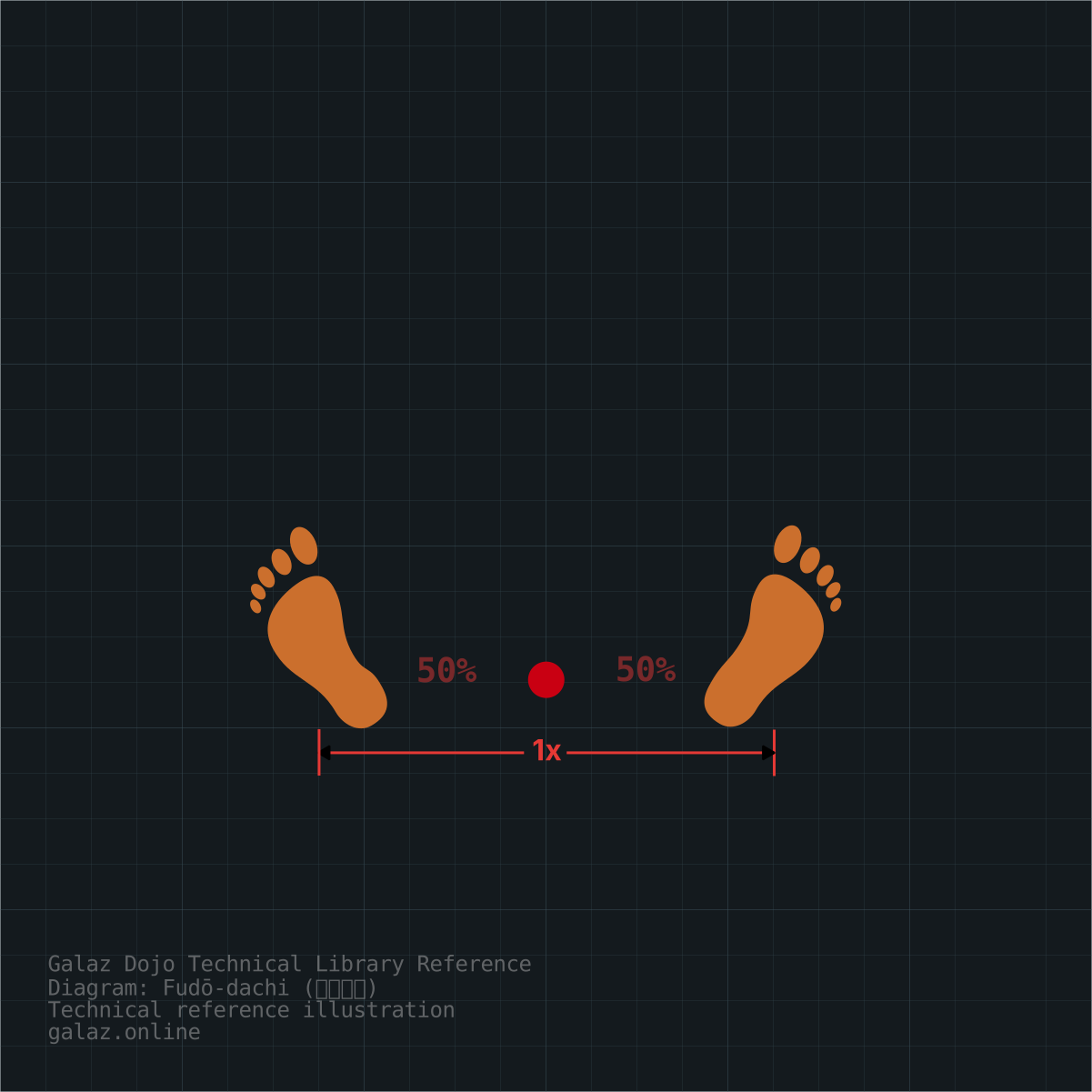
The figure shows Fudō-dachi from above as a technical reference diagram. It marks a symmetrical base, slightly outward-turned feet, and even weight distribution over both legs.
The 50/50 marking is used here pedagogically to show that the weight is carried equally over the right and left leg. The 1x marking shows the approximate width of the base in the diagram and should be understood as a practical reference, not as an exact measurement stated by Oyama.
The diagram should therefore be read as support for technical understanding, not as an absolute model for every body type.
Structure and form
Feet
The feet are placed approximately shoulder-width apart and symmetrically under the body.
The toes point slightly outward. The angle should be clear enough to distinguish the stance from a parallel foot position, but not so large that the base becomes excessively open or heavy.
The feet should maintain stable contact with the floor and provide a natural base that the body can leave easily.
Legs
The legs support the body evenly.
The knees remain soft and follow the direction of the feet. They should not be locked rigidly, collapse inward, or move outside the line of the foot.
Fudō-dachi is not a low stance. The legs should create stability and readiness, not a fixed or heavy position.
Hips
The hips are held neutrally over the base.
The pelvis should not tilt excessively forward or backward. The body should also not shift to one side. The hips should support balance without creating stiffness.
Torso and spine
The torso is held upright and organized.
The spine remains straight, the neck follows the line of the spine, and the upper body is carried vertically over the feet. The stance should feel structured, but not tense.
Shoulders, arms, and hands
The shoulders are kept naturally lowered and relaxed.
The position of the arms and hands depends on the context. In a formal yoi position, the hands may be held prepared in front of the body, but the stance itself is defined mainly by foot placement, posture, balance, and readiness.
For that reason, the hands should not become the main definition of Fudō-dachi unless the specific form, kata sequence, or instruction requires it.
Gaze
The head is held upright and the gaze is directed forward.
The gaze should support bodily organization and readiness without creating tension in the neck, jaw, or shoulders.
Weight distribution
Fudō-dachi is carried with even weight over both legs.
In this documentation, the weight distribution is given pedagogically as:
- 50% on the right leg
- 50% on the left leg
This is used to clarify the even load. It should not be understood as a separate modern measurement apart from the form of the stance, but as a pedagogical description of the balance that follows from Oyama’s description of stable stance.
The weight should not shift forward, backward, or to one side.
Center of gravity and balance
The center of gravity is kept centered between the feet.
The balance should feel natural, steady, and easy to organize. The body should be able to remain still without becoming passive, and move into the next action without first needing to correct posture or weight placement.
Fudō-dachi should therefore be experienced as a neutral form of readiness: stable, relaxed, and technically prepared.
Technical purpose
Fudō-dachi is trained to establish a stable and natural starting position.
The stance develops:
- upright body carriage
- even loading through both legs
- relaxed shoulders
- stability without stiffness
- physical readiness before technique
- control in the transition from stillness to movement
- formal composure in basic training and kata
The technical core is that the body remains still without losing readiness.
Use
Basic training
In basic training, Fudō-dachi is used to establish posture, balance, and readiness before the next exercise begins.
The stance helps the student understand the difference between simply standing and standing in a technically prepared way.
Kihon / Idō geiko
In kihon and idō geiko, Fudō-dachi may be used as a starting or return position before moving into other stances and techniques.
It then functions as a neutral point of collection between instruction, movement, and the next technical element.
Kata
In kata and formal training, Fudō-dachi or yoi-dachi appears as a ready position at the beginning of sequences, during transitions, or after a completed movement.
The stance should show control, presence, and preparation for what follows.
Kumite / application
Fudō-dachi is not primarily an active fighting stance.
In application, it may function as a formal or neutral ready position, but the body normally transitions quickly into more mobile and situation-adapted stances.
Technical key points
- place the feet approximately shoulder-width apart
- point the toes slightly outward
- keep the base symmetrical
- distribute the weight evenly over both legs
- keep the knees soft and aligned with the feet
- keep the hips neutral over the base
- keep the spine upright
- let the shoulders remain relaxed
- stand stable without becoming heavy
- maintain readiness for the next movement
- direct the gaze forward
Common mistakes
Common mistakes in Fudō-dachi are:
- keeping the feet completely parallel
- turning the feet outward too much
- making the base too wide
- making the base too narrow
- placing more weight on one leg
- locking the knees rigidly
- letting the knees collapse inward
- letting the knees move away from the direction of the feet
- shifting the hips forward, backward, or to one side
- leaning the upper body forward or backward
- lifting or tensing the shoulders
- making the hand position the main definition of the stance
- allowing the stance to become passive instead of ready
Comment
Fudō-dachi is a basic ready stance within the technical system of Kyokushin.
It expresses stability, relaxation, and preparation in a simple form. It should therefore not be trained as a heavy fighting stance, but as a natural and technically prepared starting position before the next movement.