Heikō-dachi
Name: Heikō-dachi (平行立ち)
English: Parallel stance
Introduction
Heikō-dachi is a neutral basic stance in which the feet are placed approximately shoulder-width apart, parallel to each other, with the toes pointing straight forward.
In Masutatsu Oyama’s stance system, it corresponds to parallel open stance or parallel foot stance. It is used as a simple, open basic form in which the body is held upright, evenly balanced, and centered over both legs.
The value of this stance lies in its simplicity. It trains a clear foot line, symmetrical body carriage, and neutral posture without the body leaning, turning, or loading to one side.
Definition
Heikō-dachi is a parallel basic stance in which:
- the feet are placed approximately shoulder-width apart
- both feet are kept parallel
- the toes point straight forward
- the body is held upright
- the weight is carried evenly over the right and left legs
- the hips, torso, and head are centered over the base
The stance has no clear forward, backward, or sideways loading. It should feel stable, simple, and naturally organized.
Technical figure
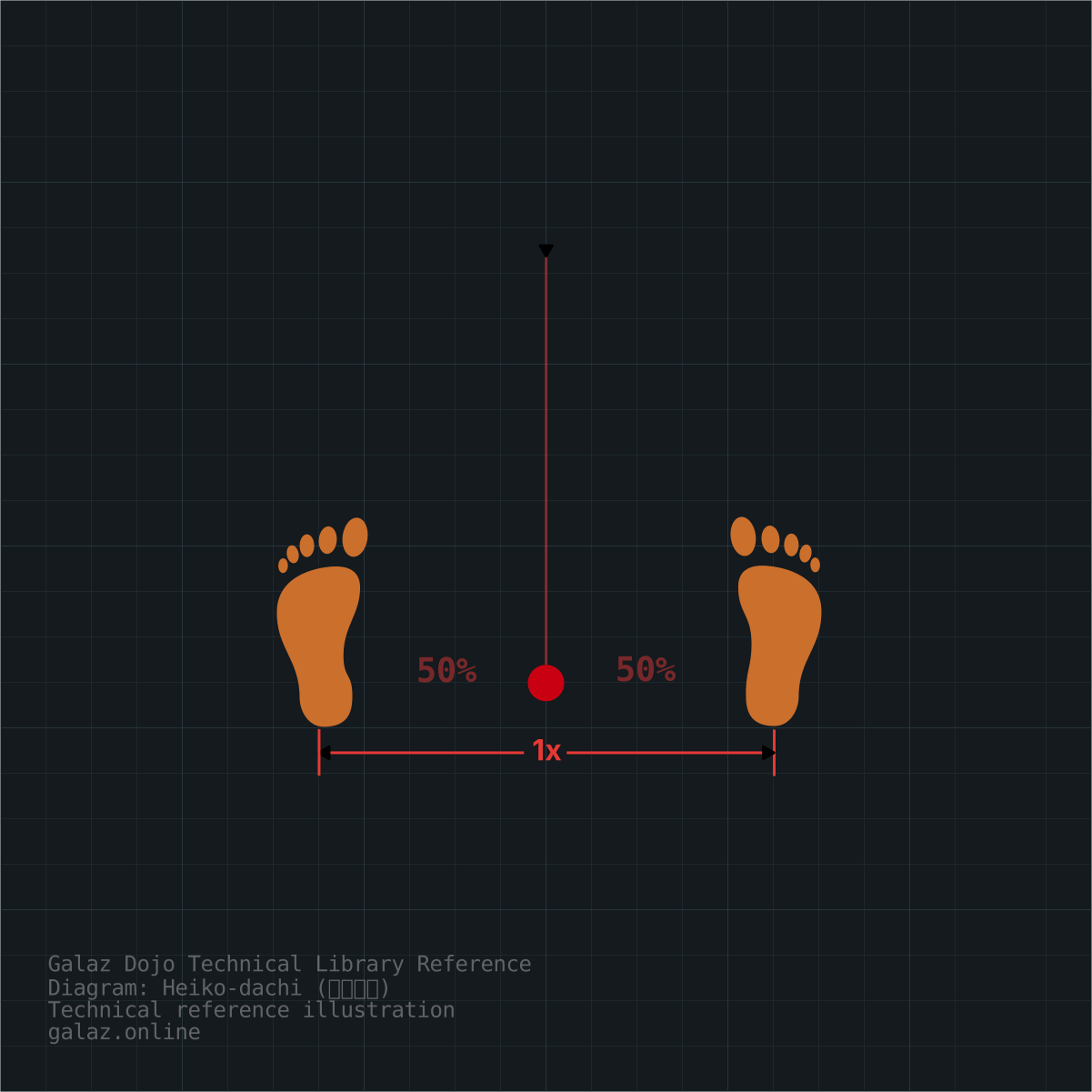
The figure shows Heikō-dachi from above as a technical reference diagram. It presents the feet parallel, approximately shoulder-width apart, with the weight evenly distributed between the right and left sides.
The 1× marking should be understood as a pedagogical proportion for approximately shoulder width. The 50/50 marking shows the symmetrical weight distribution used in this documentation. These markings are pedagogical aids and should not be read as exact measurements stated by Oyama.
Structure and form
Feet
The feet are placed approximately shoulder-width apart.
Both feet are kept parallel, and the toes point straight forward. The foot line should be clear but natural. The feet should not turn outward or inward.
The base is open sideways, but it should not be made wider than necessary.
Legs
The legs are kept naturally extended, without locking the knees rigidly.
The knees follow the direction of the feet and point forward. Both legs support the body evenly, without the stance sinking to one side.
Heikō-dachi is not a deep stance. It is based on straight, simple, and balanced body support.
Hips
The hips are kept neutral and positioned in the center of the base.
The pelvis should not be pushed forward, pulled backward, or turned to one side. The hips support the body’s vertical line and upright posture.
Torso and spine
The torso is kept gathered and the spine upright.
The neck follows the line of the spine, and the body is carried vertically. The stance should have clear form without unnecessary tension.
Shoulders, arms, and hands
The shoulders are kept lowered and relaxed.
The position of the arms depends on the context. In pure stance training, the arms may be held naturally at the sides. In kihon, kata, or yoi position, the arms and hands are shaped according to the current technique or instruction.
The arm position does not define Heikō-dachi. The stance is defined by the foot placement, the parallel foot line, and the even carriage of the body.
Gaze
The head is held upright and the gaze is directed forward.
The gaze should support the direction of the body without lifting or lowering the chin.
Weight distribution
Heikō-dachi is carried with even weight over the right and left legs.
In this documentation, the weight distribution is given pedagogically as:
- 50% on the right leg
- 50% on the left leg
This percentage is used to clarify the symmetry of the stance. Oyama’s description does not give an exact percentage for Heikō-dachi, but the form of the stance presupposes that the body is carried centrally without sideways weight displacement.
Center of gravity and balance
The center of gravity is located between the feet and follows the body’s vertical line.
The balance should feel neutral and easy to control. The body should not pull forward, backward, or to either side. This makes the stance a clear reference point for noticing whether posture, foot line, or weight distribution has shifted.
Heikō-dachi should provide stability without locking the body. From this stance, the student should be able to move into a technique, transition, or another stance without first having to correct the balance.
Technical purpose
Heikō-dachi is trained to establish a simple parallel basic structure.
The technical purpose of the stance is to:
- train parallel foot placement
- develop even weight distribution
- create a clear central axis
- establish upright posture
- make the body’s side-to-side balance easy to observe
- serve as a neutral starting point in basic training
Heikō-dachi is not primarily a deep power stance. It teaches the student to organize the body in a simple, straight, and balanced way.
Use
Basic training
In basic training, Heikō-dachi is used to teach the student to stand naturally but in an organized way.
The stance makes it easy to check whether the feet turn, whether the weight shifts to one side, or whether the torso loses its vertical line.
Kihon / Idō geiko
In kihon, Heikō-dachi may be used as a neutral starting stance or as a simple base for certain technical moments.
In idō geiko, the stance mainly functions as a reference for starting, finishing, or transitioning. It is normally not the main movement stance.
Kata
In kata, Heikō-dachi may appear as a starting, gathering, or transitional form.
When the stance is used in kata, the arms, hands, and rhythm are adapted to the specific form, but the foot principle remains the same: parallel feet, straight direction, and a centered body.
Kumite / application
In application, Heikō-dachi can be understood as a neutral base for posture, balance, and readiness.
It should not be confused with an active free-kumite stance. In kumite, footwork, guard, angle, and center of gravity change according to distance and situation. Heikō-dachi, by contrast, provides a basic reference for organizing the body before movement or technique begins.
Technical key points
- place the feet approximately shoulder-width apart
- keep the feet parallel
- point the toes straight forward
- carry the weight evenly over both legs
- let the knees follow the direction of the feet
- keep the hips neutral
- keep the spine upright
- let the shoulders stay lowered and relaxed
- keep the head naturally upright
- direct the gaze forward
- stand stable without becoming stiff
Common errors
Common errors in Heikō-dachi are:
- turning the feet outward
- turning the feet inward
- making the stance wider than necessary
- making the stance too narrow and losing the open base
- placing more weight on one leg
- letting the knees fall inward or outward in relation to the feet
- turning the hips or letting them sink to one side
- leaning the upper body forward or backward
- allowing the back to collapse
- lifting or tensing the shoulders
- making the stance loose instead of naturally organized
Comment
Heikō-dachi is a fundamental reference stance in Kyokushin’s technical system.
Through its simple form, it teaches the student to stand with parallel feet, even weight distribution, and upright body posture. When performed correctly, it becomes a clear foundation for balance, foot line, and neutral body control.