Moroashi-dachi
Name: Moroashi-dachi (諸足立ち)
English: Stance with one foot slightly forward
Introduction
Moroashi-dachi is a short, upright parallel stance in which the feet are placed approximately shoulder-width apart and one foot is positioned slightly in front of the other.
In Masutatsu Oyama’s stance system, it corresponds to one-foot-forward stance. It is not a long forward stance and not a stance with clear rear-weight emphasis, but a simple basic form for balance, direction and short movement.
The stance trains the practitioner to maintain upright posture, parallel foot alignment and even body support even when the feet are not placed in a fully symmetrical position.
Definition
Moroashi-dachi is a short asymmetrical parallel stance.
It is characterized by:
- the feet are placed approximately shoulder-width apart
- the feet are kept parallel and directed forward
- one foot is placed slightly in front of the other
- the body is held upright over the base
- the weight is carried evenly, without clear forward or rear dominance
- the stance functions as a basic, preparatory and transitional form
The stance can be performed with either the right or the left foot slightly forward.
Technical figure
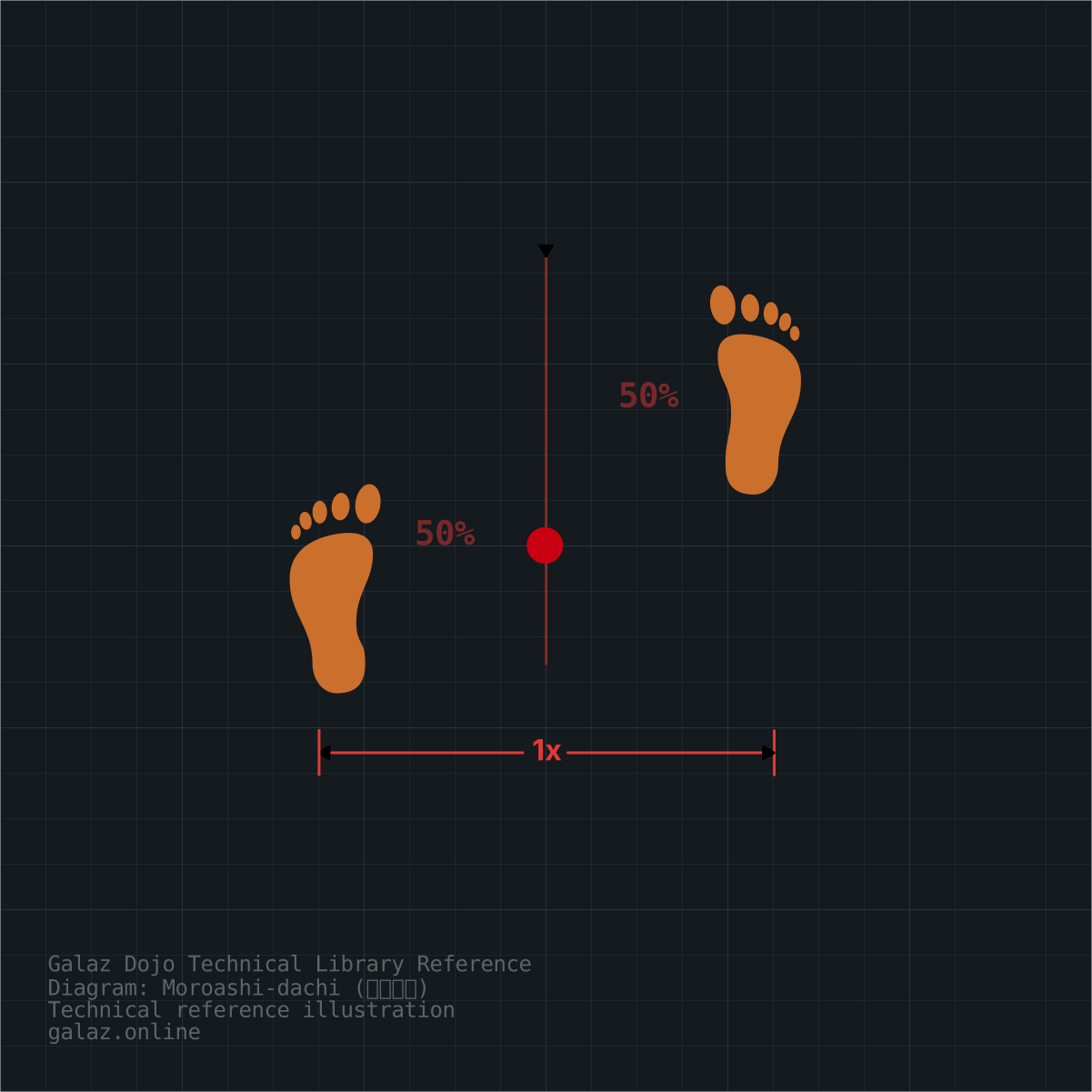
The figure shows Moroashi-dachi from above as a technical reference diagram.
The 1× marking indicates the approximate lateral width between the feet and should be understood as a pedagogical marker for about shoulder width. The 50/50 marking shows that, in this documentation, the weight is carried evenly between both feet.
Oyama states that the feet are placed approximately shoulder-width apart, kept parallel, and that one foot is slightly in front of the other. The percentage 50/50 and the visual 1× marking are pedagogical clarifications in Galaz Dojo Technical Library, not exact measurements taken from Oyama’s text.
Structure and form
Feet
The feet are placed approximately shoulder-width apart and kept parallel, with the toes directed forward. One foot is positioned slightly in front of the other.
The offset should be small but clear. If the step becomes too long, the stance loses its short character. If the offset almost disappears, Moroashi-dachi loses its specific form.
The whole sole of each foot should remain in contact with the floor, with even support through both feet.
Legs
The legs support the body evenly. The knees are kept naturally aligned over the feet and should not collapse inward or lock backward.
The stance should feel stable but not heavy. The legs remain active so that the body can continue into the next step, turn or technique.
Hips
The hips are kept neutral and gathered over the base. The pelvis should not rotate strongly toward either the front or the rear foot.
The small asymmetry in foot placement should not create unnecessary rotation in the hips or torso.
Torso and spine
The torso is held upright. The spine, neck and head follow the body’s vertical line.
The upper body should not lean forward or backward to compensate for the foot offset. The body is carried calmly above the feet.
Shoulders, arms and hands
The shoulders are kept naturally relaxed.
Moroashi-dachi does not have a fixed arm position that defines the stance. When the stance is trained as a pure form, the arms may be held neutrally. When it is used in kihon, idō geiko or kata, the arm position is determined by the technique being performed.
Gaze
The head is held upright and the gaze is directed forward in the body’s main direction.
Weight distribution
In this documentation, the weight distribution is indicated pedagogically as 50/50.
This means that the weight is carried evenly between both feet, even though one foot is placed slightly in front of the other. The marking should be understood as a practical instruction for neutral balance, not as an exact percentage from Oyama’s text.
The stance should not feel clearly front-heavy or rear-heavy. It should carry the short asymmetry without losing its centered form.
Center of gravity and balance
The center of gravity is kept close to the body’s vertical line and between the feet. It should not be pushed strongly forward toward the front foot or drawn clearly back toward the rear foot.
Balance in Moroashi-dachi should feel:
- upright
- even
- short
- mobile
- ready for the next movement
The stance trains the ability to organize the body in a slightly asymmetrical base without losing neutral support. The small foot offset creates direction, but the body should remain gathered and easy to move.
Technical purpose
Moroashi-dachi is trained to develop control over a short and simple stepping line.
The technical purpose of the stance is to:
- preserve parallel foot direction when one foot is placed slightly in front of the other
- train even weight support in an asymmetrical base
- develop upright posture without leaning
- create readiness for a short step, turn and next technique
- build understanding of how small changes in foot placement affect balance and direction
It is less power-oriented than the larger main stances, but it is important for training precision in foot placement, vertical alignment and readiness for movement.
Use
Basic training
In basic training, Moroashi-dachi is used to train parallel foot alignment, even body support and slightly asymmetrical balance.
It helps the student understand that a stance is not defined only by width, but also by the lengthwise relationship between the feet.
Kihon / Idō geiko
In movement and walking practice, Moroashi-dachi can be used to train a short stepping line without losing parallel alignment, upright posture or neutral weight support.
Oyama includes one-foot-forward-stance walk among the walking methods. This shows that the stance should not be understood only as a static foot placement, but also as part of basic movement training.
Kata
In kata, Moroashi-dachi helps the practitioner recognize short and transitional stances in which direction is marked without the body entering a long or heavy position.
The arm position, height and technical expression are then determined by the specific kata form.
Kumite / application
In application, Moroashi-dachi should be understood as a basic preparatory and transitional form, not as a complete fighting stance in itself.
It provides a short, neutral and mobile base before the next step, turn or technique.
Technical key points
- Place the feet approximately shoulder-width apart.
- Keep the feet parallel and directed forward.
- Let one foot stand slightly in front of the other.
- Carry the weight evenly between both feet.
- Keep the knees naturally aligned over the feet.
- Keep the hips neutral.
- Keep the torso upright.
- Avoid making the stance long, heavy or twisted.
Common mistakes
Common mistakes in Moroashi-dachi are:
- making the offset between the feet too large
- making the offset so small that the stance loses its form
- turning the feet outward or inward
- shifting the weight clearly forward or backward
- locking the knees or letting them collapse inward
- rotating the hips toward the front or rear foot
- leaning the upper body to compensate for the foot placement
- making the stance too heavy and losing its transitional character
Comment
Moroashi-dachi is a simple but important part of Kyokushin’s dachi system. It shows how a small offset between the feet can create direction and readiness for movement without the body leaving an even, upright and controlled basic form.
The stance should therefore be trained short, parallel, centered and ready for the next movement.