Musubi-dachi
Name: Musubi-dachi (結び立ち)
English: Open-toes stance with heels together
Introduction
Musubi-dachi is a basic standing position in which the heels are kept together and the toes are opened outward.
In Masutatsu Oyama’s system, it corresponds to open-toes stance or open foot stance. It belongs to the simple basic stances and is used primarily for formal order, composure, starting, finishing, and transition within training.
Although technically simple, the stance is important because it shows how an open foot angle can be created without leaving an upright, symmetrical, and collected basic form.
Definition
Musubi-dachi is a stance in which:
- the heels are kept together
- the toes open outward to both sides
- the body is held straight and upright
- the weight is distributed evenly between the right and left foot
- the stance is used as a formal basic, starting, finishing, or transitional position
In Oyama’s descriptions, the main criteria are that the heels are together, the toes point outward, and the body remains straight. In some instructions, the toe opening is given as approximately 60°. In practice, this angle should be understood as a guideline: the feet should open clearly, but without forcing the knees, hips, or posture out of natural alignment.
Musubi-dachi is not a power stance for heavy loading. It is a collected standing form for posture, direction, balance, and technical order.
Technical figure
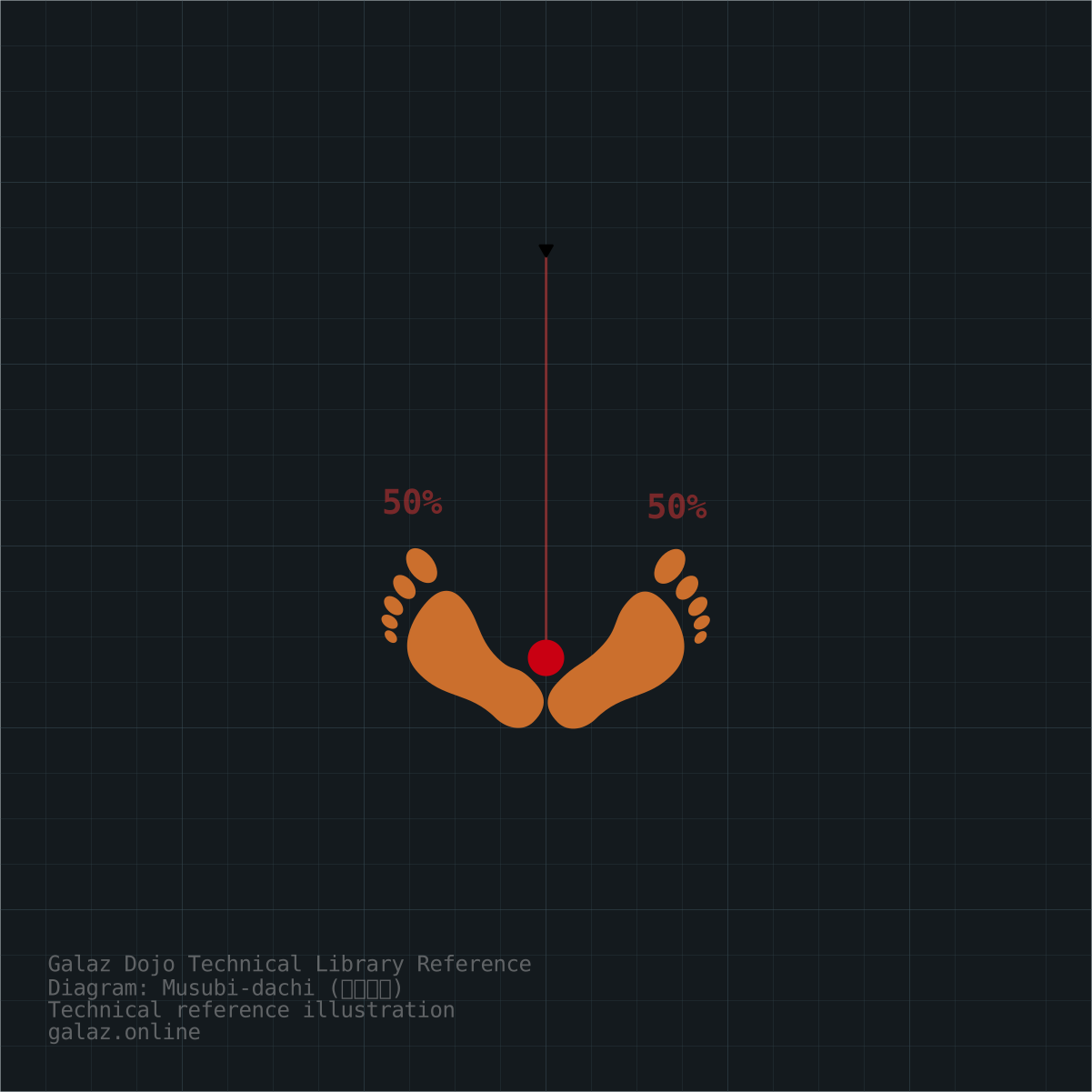
The figure shows Musubi-dachi from above as a technical reference diagram. It illustrates the heels together, the toes opened outward, and the weight evenly distributed between the right and left foot.
Any markings in the figure, such as 50/50 or proportions, should be understood as pedagogical markings within this documentation. They show how the stance should be understood in training, but they should not be read as exact measurements from Oyama unless explicitly stated.
Structure and form
Feet
The heels are kept together. The toes open outward to both sides.
The opening of the feet should be clear but natural. The feet should not be parallel, but they should also not be turned outward so far that the knees, hips, or posture are negatively affected.
Both feet support the body symmetrically.
Legs
The legs are kept straight, but not rigidly locked.
The knees follow the direction of the feet and remain neutral. They should neither collapse inward nor be forced outward. The stance should feel stable, light, and collected.
Hips
The hips remain neutral over the narrow base.
The pelvis should not tilt forward or backward. The body should rest directly over the feet, without the hips being pushed forward, backward, or to the side.
Torso and spine
The spine is held upright.
The chest and torso remain naturally collected, without excessive tension. The neck follows the line of the spine, and the body is carried vertically.
Shoulders, arms, and hands
The shoulders remain relaxed.
The arms and hands are placed according to context. In formal moments, they may be held naturally at the sides or placed according to the position required by kata, kihon, or closing procedure.
The hand position is therefore not the main criterion of the stance. What matters is that the heels are together, the toes open outward, the body is straight, and the balance is even.
Gaze
The head is held upright and the gaze is directed forward.
The chin should neither be lifted nor pressed downward. The gaze should be calm, collected, and aligned with the body’s main line.
Weight distribution
In this documentation, the weight distribution is given pedagogically as:
- 50% on the right foot
- 50% on the left foot
There is no intended forward or backward weighting in Musubi-dachi. The body should be carried evenly over both feet, with the same load on the right and left side.
Center of gravity and balance
The center of gravity is located centrally over the collected base, with the body carried along a straight vertical line.
Because the base is narrow, Musubi-dachi is not intended for heavy power generation or active fighting readiness. Instead, it trains simple and controlled balance:
- the body stands straight
- the center line remains collected
- the foot angle is controlled
- the weight is distributed evenly
- the body is ready for the next formal movement
The stance should feel orderly and centered, not stiff.
Technical purpose
Musubi-dachi is trained to establish a simple open basic form.
The stance develops:
- symmetrical body posture
- even weight distribution
- understanding of an open foot angle
- control of the knees and hips in a narrow base
- formal readiness for starting, finishing, or transition
In Kyokushin’s basic system, Musubi-dachi serves as an early reference for how the foot angle can change while the body remains upright, collected, and balanced.
Use
Basic training
In basic training, Musubi-dachi is used to practise simple posture, even weight distribution, and orderly foot placement.
The stance helps the student feel the difference between a fully closed foot position and an open but still symmetrical standing form.
Kihon / Idō geiko
Musubi-dachi is normally not used as the main working stance for powerful kihon or idō geiko.
It appears primarily as a gathering, starting, or transitional stance before the body moves into a more active technical stance.
Kata
In kata, Musubi-dachi may appear at the beginning, at the end, or as a transition, depending on the kata and its execution.
In that context, the stance marks composure, direction, and formal control rather than combative loading.
Kumite / application
Musubi-dachi is not an active kumite stance.
It may appear in formal moments before or after kumite, but actual fighting readiness normally shifts into a more mobile and functional position.
Technical key points
- keep the heels together
- open the toes clearly but naturally outward
- stand straight and upright
- distribute the weight evenly between both feet
- keep the knees aligned with the feet
- keep the hips neutral
- let the shoulders remain relaxed
- direct the gaze forward
Common mistakes
Common mistakes in Musubi-dachi are:
- opening the toes too little, making the stance almost parallel
- opening the toes too much, placing incorrect stress on the knees and hips
- allowing the heels to separate
- opening the feet unevenly
- letting the knees collapse inward
- shifting the hips forward, backward, or to the side
- leaning the body forward or backward
- tensing the shoulders and arms unnecessarily
- making the stance stiff instead of collected and relaxed
Comment
Musubi-dachi is a simple but important basic stance within Kyokushin’s stance system.
By joining the heels and opening the toes, it creates a clear transition from a closed standing form to an open foot structure. Its value is not in power generation, but in order, posture, direction, and formal readiness.