Uchihachiji-dachi
Name: Uchihachiji-dachi (内八字立ち)
English: Inward eight stance / pigeon-toe stance
Introduction
Uchihachiji-dachi (内八字立ち) is a symmetrical basic stance in which the feet are placed approximately shoulder-width apart, the toes point inward, and the heels remain outward.
In Masutatsu Oyama’s terminology, this stance corresponds to pigeon-toe stance. It belongs to the simple basic stances within Kyokushin’s foundational system, where the upper body is kept upright and natural while the angle of the feet changes. The stance is mainly used to train posture, even weight distribution, and control of the knee and hip line in an inward-facing foot position.
Definition
Uchihachiji-dachi is an inward-facing basic stance in which:
- the feet are placed approximately shoulder-width apart
- the toes point inward
- the heels remain outward
- the knees lightly follow the line of the feet without collapsing inward
- the weight is carried evenly between the right and left foot
- the upper body is kept straight, natural, and centered
The function of the stance is to train a stable and collected body posture over a foot position that requires clear control of the feet, knees, hips, and trunk.
Technical figure
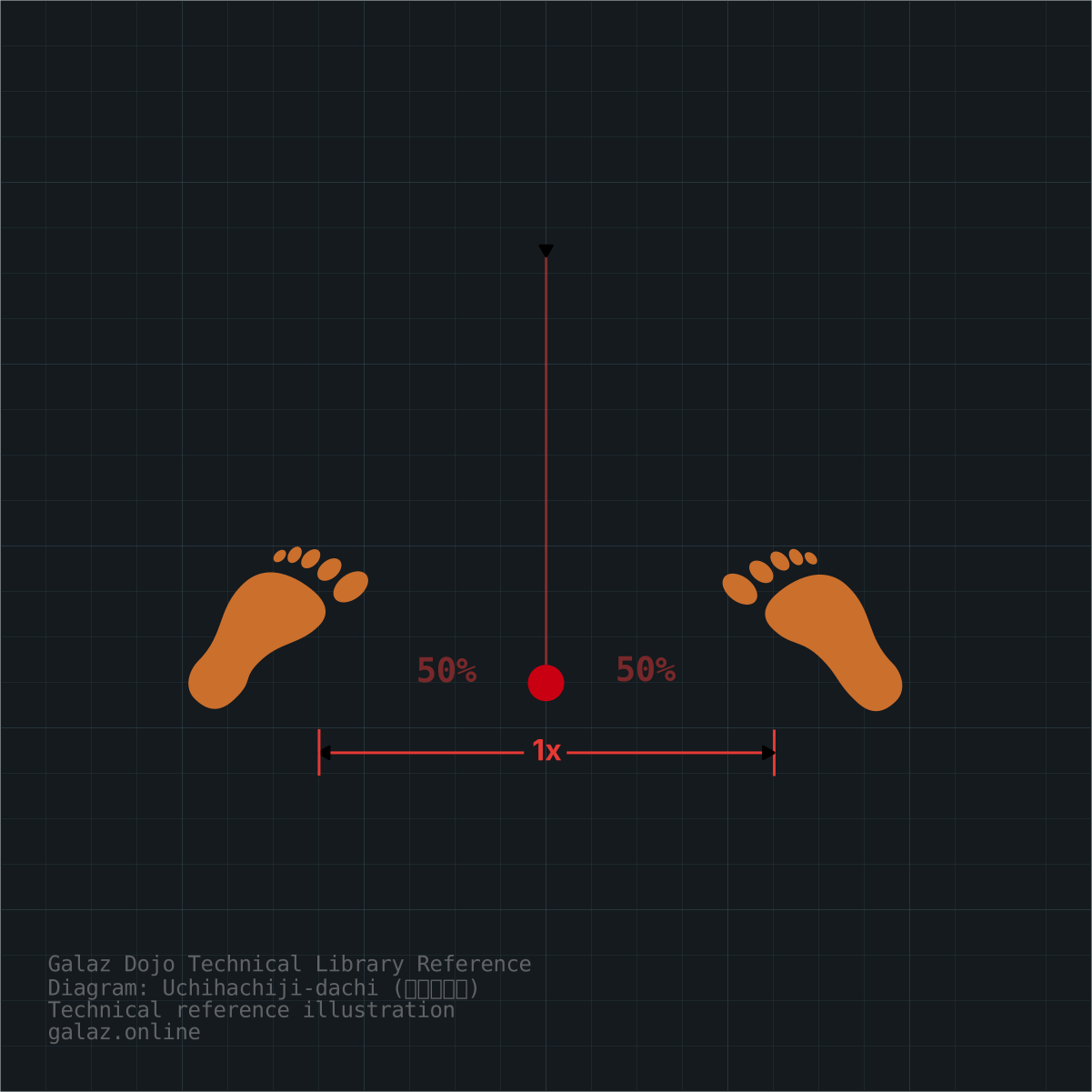
The figure shows Uchihachiji-dachi from above as a technical reference diagram. It marks the inward foot line, the symmetrical base, and the even weight distribution between the right and left foot.
The 1× marking should be understood as a pedagogical indication of approximate shoulder width. The 50/50 marking shows even weight distribution between both feet. The percentage notation is a modern pedagogical marking in this documentation, although the principle of even weight is consistent with Oyama’s description of the stance.
Structure and form
Feet
The feet are placed approximately shoulder-width apart. The toes point inward and the heels remain outward, creating the inward foot line that characterizes the stance.
Both feet should maintain stable contact with the floor. The pressure is distributed evenly through the soles without the body falling excessively toward the inside or outside edge of the foot.
Legs
The legs support the body symmetrically. The knees lightly follow the inward line of the feet, but without collapsing or twisting under tension.
The knees should not be locked rigidly. They are kept alive and slightly naturally bent so that the stance retains balance, mobility, and control.
Hips
The hips are kept neutral over the base. The pelvis should not tilt forward or backward, and the body should not sink toward one side.
Because the feet are turned inward, the hips must remain centered. The angle of the feet must not create uncontrolled rotation in the knees, hips, or trunk.
Trunk and spine
The trunk is kept upright and the spine follows a straight, natural line. The neck follows the line of the spine and the head is carried without being pushed forward.
The upper body should not lean forward, backward, or to the side. In this type of basic stance, it is mainly the foot position that changes; the vertical posture of the body should be maintained.
Shoulders, arms, and hands
The shoulders are kept relaxed and level. The arms and hands are positioned according to the training context.
When the stance is trained as a simple basic form, the arms may be held naturally at the sides. In breathing exercises, kata, or formal training, the arm position may vary. The placement of the arms should therefore not be seen as a fixed part of the stance’s foot structure.
Gaze
The gaze is directed straight ahead. The head is held naturally upright and should not turn or sink to compensate for the angle of the feet.
Weight distribution
In this documentation, the weight distribution is given pedagogically as 50 % / 50 %.
This means that the weight is carried evenly between the right and left foot. The stance has no intended forward or backward weighting and should not be loaded onto one leg.
The even weight distribution is central to the neutral character of the stance. The foot line is inward-facing, but the body’s weight should still remain collected over the center.
Center of gravity and balance
The center of gravity is located centrally between the feet.
The balance should feel collected, vertical, and even. The inward foot line makes small errors in the knees, hips, and trunk easy to detect. The body should therefore not be pulled inward by the angle of the feet, but remain organized over its vertical line.
The stance trains the ability to stand stable without becoming heavy. It should maintain readiness for the next movement, especially in formal training and in transitions between positions.
Technical purpose
Uchihachiji-dachi is trained to develop control over body posture, balance, and leg alignment in an inward-facing foot position.
The stance particularly develops:
- awareness of foot direction
- control of the knee line
- symmetrical weight support
- neutral hip position
- upright body posture
- collected balance over an inward-facing base
It is not primarily a power stance for forward drive, but a structural basic stance that reveals weaknesses in alignment, balance, and body control.
Use
Basic training
In basic training, Uchihachiji-dachi is used to train simple but demanding body control. The student learns to maintain even weight, straight posture, and a stable knee line even when the feet point inward.
The stance is especially useful for feeling how foot angle affects the knees, hips, center of gravity, and the body’s vertical line.
Kihon / Idō geiko
Uchihachiji-dachi is not used as a main movement stance in kihon or idō geiko. Its value lies mainly in form training, posture, breathing work, and basic body control.
When it appears in technical sequences, it should be performed clearly but without excessive tension.
Kata
In kata and formal training, Uchihachiji-dachi may appear in opening moments, transitions, or in connection with breathing and body collection.
When the stance is used in kata, the foot form should be clear, the weight even, and the upper body straight. The stance must not become artificial or so tense that the next movement is made difficult.
Kumite / application
Uchihachiji-dachi is normally not used as a primary fighting stance in kumite. However, it has pedagogical value for developing control over the relationship between foot, knee, hip, and center of gravity.
It can therefore be understood as a basic structural stance rather than a direct fighting stance.
Technical key points
- Place the feet approximately shoulder-width apart.
- Point the toes inward and the heels outward.
- Distribute the weight evenly between both feet.
- Let the knees lightly follow the line of the feet without collapsing.
- Keep the hips neutral and centered.
- Keep the trunk and spine upright.
- Keep the shoulders and arms relaxed.
- Direct the gaze straight ahead.
Common errors
Common errors in Uchihachiji-dachi are:
- placing the feet too narrow or too wide
- turning the toes inward so little that the stance loses its form
- turning the toes inward too much and stressing the knees
- allowing the knees to collapse inward without control
- locking the legs rigidly instead of keeping them alive
- placing more weight on one leg
- twisting the hips or letting them sink to one side
- leaning the upper body to compensate for the angle of the feet
- creating unnecessary tension in the shoulders and arms
- making the stance artificial instead of stable and collected
Comment
Uchihachiji-dachi is a simple but technically revealing basic stance. Through the inward foot line, it tests the student’s ability to maintain even weight, straight posture, and controlled leg alignment. It therefore has clear value in Kyokushin’s basic system as training in structure, balance, and body control.