Heisoku-dachi
Name: Heisoku-dachi (閉足立ち)
English: Closed-foot stance
Introduction
Heisoku-dachi (閉足立ち) is a closed and upright basic stance in which the feet are kept together, parallel and directed straight forward.
In Masutatsu Oyama’s basic system, this stance corresponds to normal stance. It is not primarily used as a fighting stance, but as a simple reference form for upright posture, symmetry and a gathered body line.
Heisoku-dachi shows whether the practitioner can stand still, straight and controlled before moving into other stances, techniques or formal moments.
Definition
Heisoku-dachi is an upright stance in which:
- the feet are kept together from toes to heels
- both feet are parallel
- the toes point straight forward
- the body is carried vertically over the closed base
- the weight is distributed evenly between the right foot and the left foot
The function of the stance is to create a clear, neutral and symmetrical basic position.
Technical figure
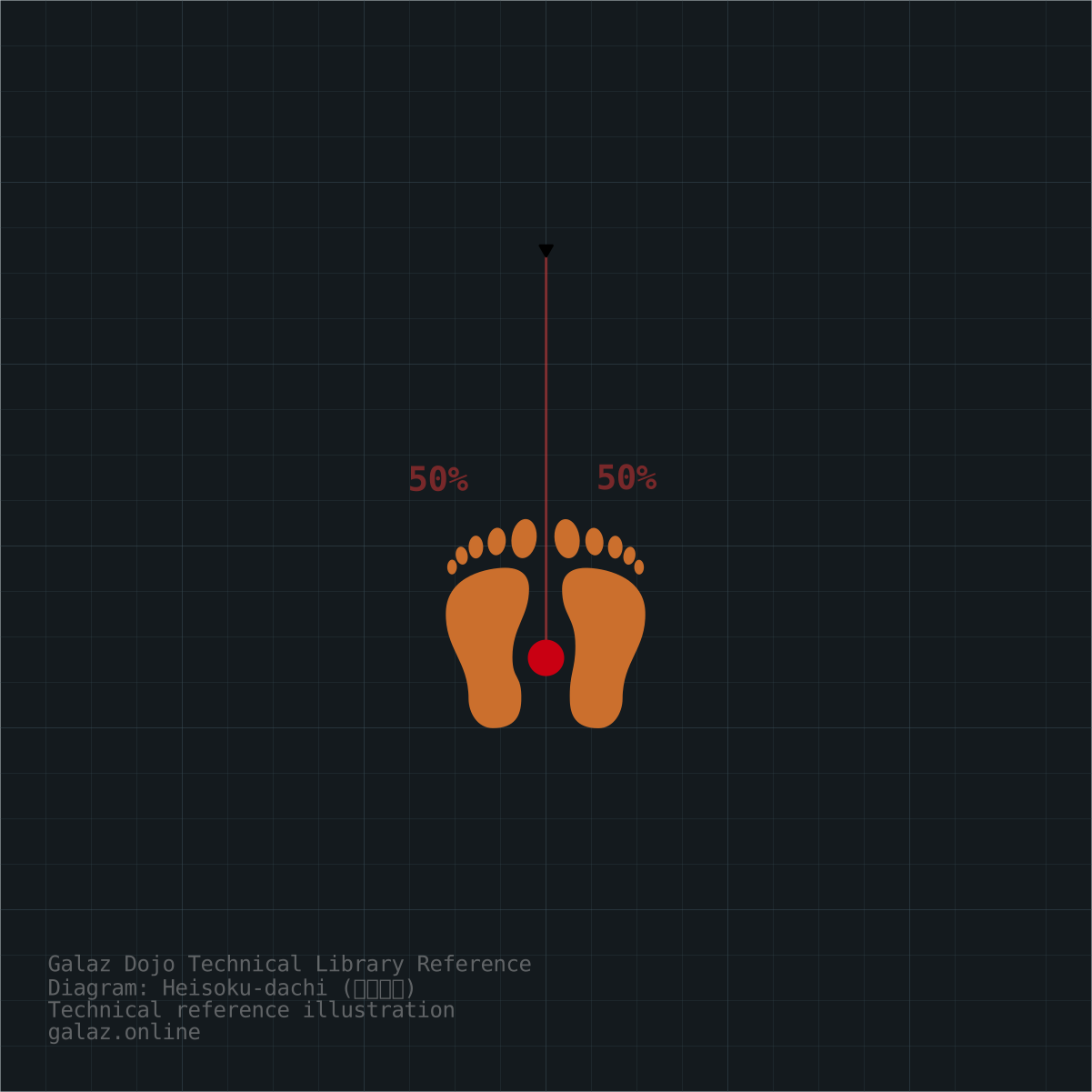
The figure shows Heisoku-dachi from above as a technical reference diagram. It shows the feet parallel, directed forward, and the body centered between the right and left sides.
The 50/50 marking is a pedagogical marking that shows even weight distribution between both feet. It should not be understood as an exact percentage measurement stated by Oyama for Heisoku-dachi.
If the figure shows a small graphical gap between the feet, this should be understood as a visual simplification to make the foot shapes readable. In actual execution, the feet are closed from toes to heels.
Structure and form
Feet
The feet are kept closed, with the inner edges together from toes to heels. Both feet point straight forward and remain parallel.
The toes should neither open outward nor turn inward. The closed and parallel foot line is what defines Heisoku-dachi.
Legs
The legs are kept naturally extended and gathered. The knees should be organized over the feet, without being pushed backward or locked rigidly.
Because the stance is narrow, it is not based on a deep lowering or a wide base. Stability instead comes from straight alignment, even weight-bearing and body control.
Hips
The hips are kept neutral over the feet. The pelvis should not tilt forward or backward.
The hips should not be pushed forward, pulled back or turned to one side. The lower body and upper body are kept gathered around the body’s vertical line.
Torso and spine
The torso is held upright. The spine and neck form a straight line, without the upper body leaning forward, backward or to the side.
The posture should be straight, but not stiff. The chest is not lifted excessively and the back should not be arched.
Shoulders, arms and hands
The shoulders are kept relaxed and naturally placed.
In the basic form, the arms may fall along the sides, and the hands may be held naturally or clenched depending on the formal context. In kata, ceremonial order or transitions, the position of the arms may vary.
The stance itself is defined by the foot placement, the upright body and the gathered form, not by a fixed arm position.
Gaze
The head is kept naturally upright and the gaze is directed straight forward.
The gaze should not drop toward the feet and the head should not project forward. The line of the neck follows the line of the spine.
Weight distribution
In this documentation, the weight distribution is indicated pedagogically as:
- 50% on the right foot
- 50% on the left foot
This expresses that the body is carried evenly between both sides. The weight should not fall more onto one foot, shift forward onto the toes or shift backward onto the heels.
The percentage is a pedagogical marking used to clarify the symmetry of the stance. It is not an exact measurement stated by Oyama.
Center of gravity and balance
The center of gravity is kept over the closed base, midway between the feet.
Because the base is narrow, Heisoku-dachi requires good control of the body’s vertical line. The stance should feel straight, calm and centered, without the body becoming tense.
The balance mainly trains stillness, equality between both sides and the ability to gather the body before the next movement. Heisoku-dachi is therefore not a wide stability stance, but a reference for upright posture and symmetrical body carriage.
Technical purpose
Heisoku-dachi is practiced to establish a simple and gathered basic form.
The stance develops:
- upright body posture
- parallel foot line
- even weight-bearing
- control of the body’s vertical line
- stillness without unnecessary tension
- formal gathering before or between technical moments
In Oyama’s stance system, Heisoku-dachi functions as a basic reference for the upright body. When other simple stances are built by changing the placement of the feet, the same organization of the upper body should be maintained.
Use
Basic training
In basic training, Heisoku-dachi is used to train upright posture, a gathered body line and even weight distribution.
The stance makes it easy to observe whether the student is centered, whether the feet are correctly organized and whether the body can remain calm without excessive tension.
Kihon / Idō geiko
Heisoku-dachi is normally not a main working stance for kihon or idō geiko.
It is mainly used as a starting form, gathering form or transition position. When it appears in connection with technical training, it helps the student return to a neutral and organized body posture.
Kata
In kata and formal exercises, Heisoku-dachi may appear as a starting stance, gathering stance or transitional form.
The position of the arms is then determined by the kata and the specific moment. The central elements are the foot position and the upright body.
Kumite / application
Heisoku-dachi is not a practical fighting stance in the narrow sense. The narrow base gives limited readiness for movement compared with more open and functional fighting stances.
Its importance for kumite is therefore indirect. It trains posture, balance line and body control, which must also be present when the body later moves freely.
Technical key points
- keep the feet together from toes to heels
- direct both feet straight forward
- keep the feet parallel
- distribute the weight evenly between the right and left foot
- carry the body vertically over the closed base
- keep the knees naturally extended without locking them rigidly
- keep the shoulders relaxed
- keep the gaze straight forward
- stand gathered without becoming stiff
Common errors
Common errors in Heisoku-dachi are:
- turning the toes outward so that the stance begins to resemble Musubi-dachi
- keeping the feet close together but not parallel
- failing to close the inner edges of the feet from toes to heels
- allowing the weight to fall more onto one foot than the other
- placing the weight too far forward on the toes or too far back on the heels
- leaning the body forward, backward or to the side
- pushing the knees backward and locking them rigidly
- tilting the pelvis forward or backward
- pushing the chest forward and arching the back
- lifting or tensing the shoulders
- letting the head fall forward and lowering the gaze
- making the stance stiff instead of gathered
Comment
Heisoku-dachi is a simple but important reference stance within Kyokushin’s dachi system.
Through its closed and parallel form, it shows whether the practitioner can carry the body straight, calmly and symmetrically. It therefore functions as a basic checkpoint for posture, balance and formal bodily gathering.