Kokutsu-dachi
Name: Kokutsu-dachi (後屈立ち)
English: Back-weighted stance / back leaning stance
Introduction
Kokutsu-dachi is a directed, back-weighted stance in which most of the body weight is carried by the rear leg, while the front leg remains lighter and less loaded.
In Masutatsu Oyama’s basic description, this stance corresponds to back leaning stance. It trains the ability to carry the body backward without losing posture, direction, or readiness for the next action. Within the basic Kyokushin system, it is used especially for balance, receiving techniques, movement, and formal structure in kata.
Definition
Kokutsu-dachi is an asymmetrical stance in which one foot is placed in front of the other and the body is carried backward through a clear shift of weight toward the rear leg.
The stance is characterized by:
- the front foot pointing forward
- the rear foot angled outward
- both legs bent
- most of the weight placed on the rear leg
- the upper body held upright and organized
- a structure that provides balance, control, and readiness for the next movement
In this documentation, the weight distribution is given as 70% on the rear leg and 30% on the front leg, in line with Oyama’s description of the stance.
Technical figure
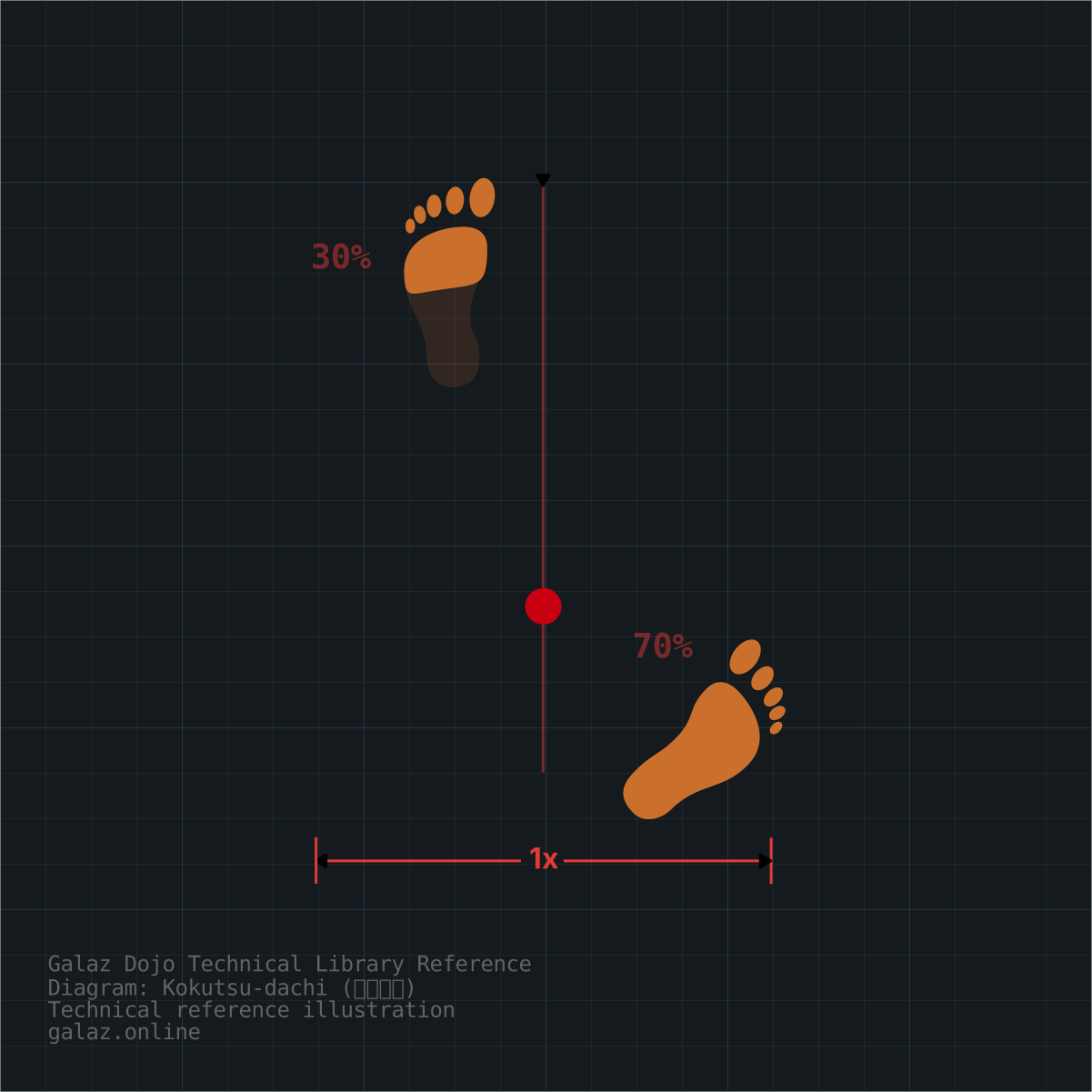
The figure shows Kokutsu-dachi from above as a technical reference diagram. The front foot is shown in the direction of the technique with lighter load, while the rear foot carries most of the weight and is angled outward.
The 70% / 30% marking shows the back-weighted character of the stance and is consistent with Oyama’s description of back leaning stance. The 1× marking, however, should be understood as a pedagogical proportion marker in the diagram, not as an exact measurement stated by Oyama.
The diagram should be read as support for foot placement, direction, weight distribution, and balance. It does not replace the bodily adjustment that takes place in training under an instructor’s correction.
Structure and form
Feet
One foot is placed in front of the other. The front foot points forward in the direction of the technique and is held lighter, but not passive. The toes should remain active so that the foot maintains contact, control, and readiness.
The rear foot is placed behind and slightly outside the line of the front foot. It is angled outward, in practical Kyokushin teaching often around 45°. This angle should be understood as a pedagogical guideline for the opening of the foot, not as an absolute measurement that must look identical in every practitioner.
The base should be long and wide enough to create clear back weight without allowing the body to fall backward or the front leg to become empty.
Legs
Both legs are bent. The rear leg carries most of the body weight and should feel active, strong, and working. The front leg is lighter, but maintains contact with the floor and direction forward.
The knees are kept aligned with the direction of the feet. The rear knee must not collapse inward, and the front knee should not lock or collapse. The stance should feel low and controlled, but not so low that mobility is lost.
Hips
The hips are kept low, gathered, and technically organized. The pelvis should remain neutral enough for the upper body to stay upright, while the weight is clearly carried backward.
In practice, the hips should not rotate away from the direction of the stance or lose the structural tension of the base. Feet, legs, and hips should work together so that the stance becomes firm without becoming rigid.
Torso and spine
The spine is held upright and the body is carried backward as a whole. This means that the stance is back-weighted, not that the upper body hangs backward or breaks at the waist.
The head, chest, pelvis, and rear leg should feel organized over the base. The body must be stable enough to receive force, while still being ready to move.
Shoulders, arms, and hands
The position of the arms is determined by the technique being performed. In pure stance training, the arms may be held neutrally, while in kihon, idō geiko, and kata they follow the relevant block, strike, or transition.
Kokutsu-dachi often appears together with receiving or protective techniques, such as chūdan uchi uke and shutō mawashi uke. The important point is that the arm technique must not pull the body out of its back-weighted structure.
Gaze
The gaze is held in the direction of the technique. The head remains natural and upright, without lifting the chin or tensing the neck backward.
Weight distribution
Kokutsu-dachi is carried with most of the weight on the rear leg.
In this documentation, the weight distribution is given as:
- 70% on the rear leg
- 30% on the front leg
This is a central characteristic of the stance. The front foot should be lighter and less loaded, but it must not lose contact, direction, or function. If the weight becomes too evenly distributed between the legs, the stance loses its back-weighted character. If the front leg becomes completely empty, the form begins to approach another type of back-weighted stance.
Center of gravity and balance
The center of gravity is kept low and shifted toward the rear leg. The balance should feel gathered, not hanging. The practitioner should be able to remain stable, but also move on to a block, step, kick, or counter technique.
Kokutsu-dachi therefore trains a specific form of balance: the body is not evenly distributed between both legs, but it must still not lose its center. The rear loading should provide control, while the front leg maintains readiness and direction.
Technical purpose
Kokutsu-dachi is trained to develop control over back-weighted body structure.
The technical purpose of the stance is to:
- create stable rear loading
- develop balance in an asymmetrical base
- strengthen the supporting function of the rear leg
- unload the front leg without losing contact
- provide a base for receiving and protective techniques
- prepare the transition to a step, kick, or counterattack
- train hip control and bodily organization
The stance should not be understood as a passive resting position. It should be active, low, and ready for the next movement.
Use
Basic training
In basic training, Kokutsu-dachi is used to practice rear loading, low center of gravity, leg control, and posture. It helps the practitioner understand how the body can be carried backward without the upper body leaning incorrectly or the front foot losing function.
Kihon / Idō geiko
In kihon and idō geiko, Kokutsu-dachi is often used together with techniques where the body needs to be gathered backward, especially in receiving blocks and transitions. When moving into the stance, the movement should be smooth and continuous, without dividing the step into several separate corrections.
Kata
Kokutsu-dachi has a clear place in kata. It is often used as a base for blocks and receiving techniques, especially in sequences where the body needs to be back-weighted while still directed forward.
Kumite / application
In kumite, Kokutsu-dachi is rarely used as a long-held formal stance. However, its principle remains important: the body can be briefly carried backward to receive, evade, create distance, or prepare a counter movement. The formal stance therefore trains a bodily principle that can be expressed more dynamically in application.
Technical key points
- Point the front foot forward.
- Angle the rear foot outward.
- Bend both legs.
- Place most of the weight on the rear leg.
- Keep the front leg lighter, but active.
- Lower the center of gravity without losing mobility.
- Keep the hips gathered and stable.
- Keep the spine upright.
- Carry the body backward without breaking the upper-body posture.
- Keep the gaze in the direction of the technique.
Common mistakes
Common mistakes in Kokutsu-dachi are:
- distributing the weight too evenly between both legs
- allowing the weight to shift forward so the rear loading is lost
- leaning the upper body backward instead of carrying the whole stance backward
- making the front leg completely passive or stiff and locked
- allowing the rear knee to collapse inward
- angling the rear foot too much or too little
- rotating the hips away from the direction of the stance
- making the stance too high and losing support
- entering the stance through a broken movement that requires correction afterward
- allowing the arm technique to pull the body out of balance
Comment
Kokutsu-dachi is a central stance for understanding back weight, balance, and receiving structure in Kyokushin. It teaches the practitioner to carry the body low and gathered on the rear leg, while preserving direction, posture, and readiness. The value of the stance therefore lies not only in the 70/30 distribution, but in the ability to make the rear loading active and useful.