Nekoashi-dachi
Name: Nekoashi-dachi (猫足立ち)
English: Cat stance
Introduction
Nekoashi-dachi is a compact, rear-weighted stance in which most of the body weight is carried by the rear leg while the front foot remains light, with the heel raised from the floor.
In the basic system of Kyokushin, this stance trains the ability to carry the body backward without losing readiness toward the front. The front foot must be available for a quick step, block, distance adjustment, or kick. For this reason, the stance functions both as a formal basic stance and as a practical working position in technique, kata, and preparatory fighting form.
Definition
Nekoashi-dachi is an asymmetrical stance in which:
- the rear foot and rear leg carry most of the body weight
- the front foot is placed in front of the body with the heel raised
- the ball or front part of the front foot maintains light contact with the floor
- the body is held upright and gathered, without leaning the upper body backward
- the stance is compact, controlled, and ready for a quick transition
The function of the stance is to combine rear stability with a free and usable front leg.
Technical figure
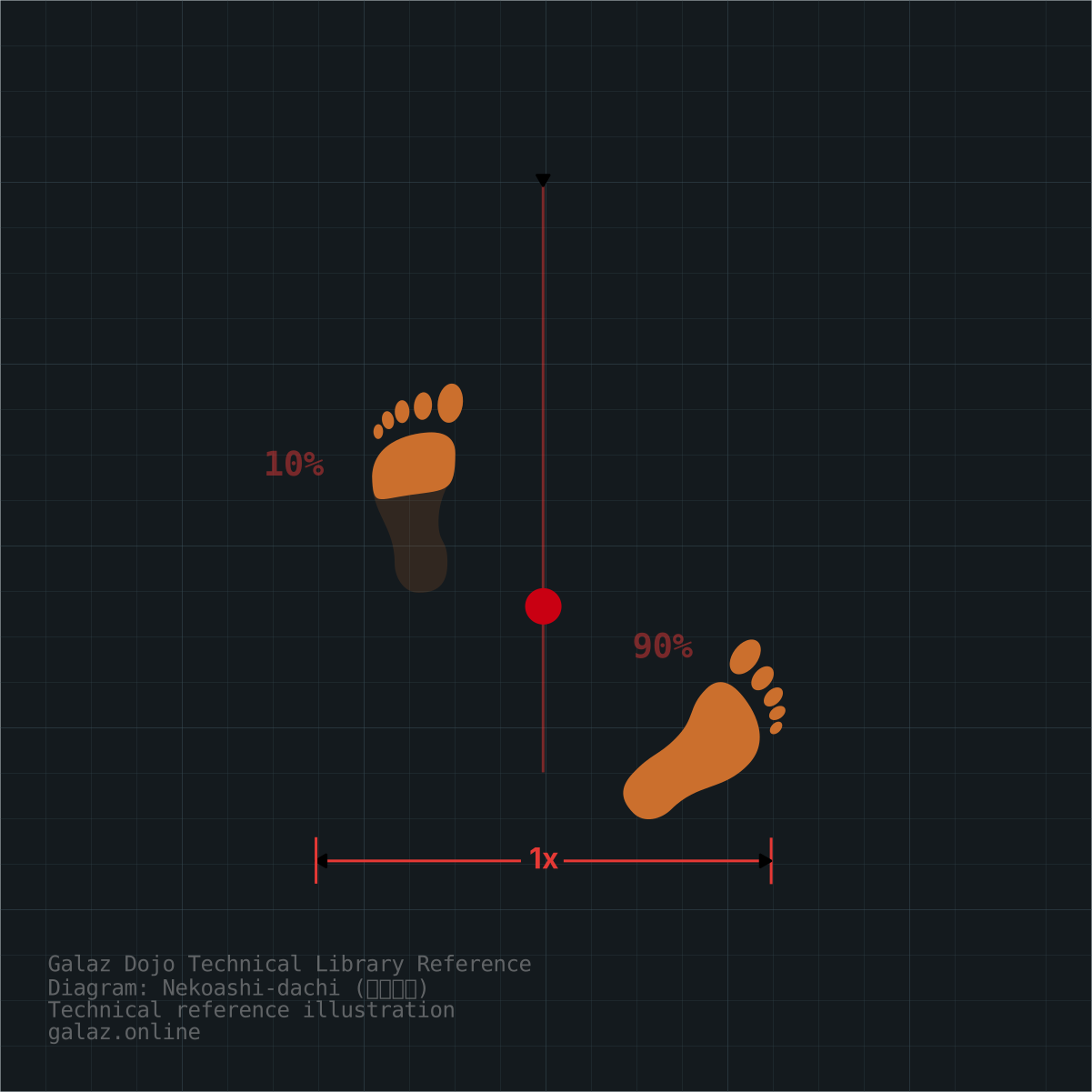
The figure shows Nekoashi-dachi from above as a technical reference diagram. It is intended to clarify foot placement, rear weighting, the raised front heel, and the compact structure of the stance.
Any measurements, angles, or percentage markings in the diagram should be understood as pedagogical indicators. The diagram shows the principle of the stance, not an absolute standard for every body type or training situation.
Structure and form
Feet
One foot is placed in front of the other. The front foot is kept light, with the ankle flexed and the heel lifted from the floor. Only the front part of the foot maintains contact with the ground.
The rear foot carries the main load of the stance. The base should be compact and controlled. The stance must not become so long that the front foot becomes heavy, or so narrow that balance is weakened.
In Oyama’s descriptions, the main emphasis is not on an exact distance between the feet, but on keeping the front foot light and carrying the body weight clearly toward the rear.
Legs
The rear leg actively supports the body. The knee is bent enough to carry the weight and allow movement, but it should not be forced too deeply downward.
The front leg is unloaded, but not passive. It should remain light, alive, and ready to be lifted, moved, or used for kicking. Both legs therefore work within the stance, but with clearly different functions.
Hips
The hips are kept gathered over the base. The pelvis should remain neutral and controlled, without dropping or collapsing backward.
The stance is carried toward the rear through the structure of the legs and the body’s center, not by pushing the hips back or hanging on the rear leg. The hips must be able to transfer force into a block, step, kick, or counter-technique.
Torso and spine
The torso is held upright and gathered. The spine lengthens naturally, the neck remains free, and the head is balanced above the body.
Rear weighting is not created by leaning the upper body backward. If the torso falls back, the stance loses both balance and readiness. The body’s vertical line should feel stable and controlled over the rear leg.
Shoulders, arms, and hands
The shoulders are kept relaxed and organized. The position of the arms and hands depends on the context.
In pure form training, the arms may be held neutrally or according to the dojo form being used. In kihon, idō geiko, kata, and kumite, the arm position is determined by the technique being performed, such as a block, guard, shuto-waza, shōtei-waza, or another hand technique.
The basic function of the stance does not change because of the hand position: the body should still be rear-weighted, compact, and ready to change.
Gaze
The head is held upright and the gaze is directed forward, in the direction of the technique. The expression should be alert and present, not tense.
Weight distribution
Nekoashi-dachi is clearly rear-weighted.
In this documentation, the weight distribution is given pedagogically as approximately 10–20 percent on the front leg and 80–90 percent on the rear leg. This follows Oyama’s balance principle for cat stance and indicates that the front leg should be light but still technically active.
When the stance is trained more strictly, the distribution may be close to 10 percent front and 90 percent rear. The important point is not to become fixed on an exact number, but to ensure that the front foot does not become weight-bearing in the same way as the rear leg.
Center of gravity and balance
The center of gravity is kept low and toward the rear, but the body must not become heavy or passive. Balance should feel gathered over the rear leg while the front foot remains free.
A correct Nekoashi-dachi provides:
- rear stability
- a light front leg
- quick transition into a kick or step
- the ability to receive, break, or redirect an attack
- control of the body’s center even within a small base
The stance requires particular balance control because the contact of the front foot is limited. The practitioner must therefore be able to carry the weight backward without losing the vertical line, hip control, or readiness to move.
Technical purpose
Nekoashi-dachi is trained to develop rear weighting while maintaining mobility.
The stance particularly develops:
- control over the support of the rear leg
- the ability to keep the front leg free
- balance in a compact asymmetrical structure
- readiness for kicking, stepping, and changing direction
- coordination between the hips, torso, and legs
- technical stability in blocks and receiving movements
The stance teaches the practitioner to be stable without becoming locked, and mobile without becoming loose.
Use
Basic training
In basic training, Nekoashi-dachi is used to train rear weighting, balance, and control of the front leg. The stance helps the student understand the difference between unloading a leg and letting it become passive.
It also trains the body’s vertical line. The practitioner must be able to keep the upper body upright even when the weight is clearly shifted to the rear.
Kihon / Idō geiko
In kihon and idō geiko, Nekoashi-dachi is used when the technique requires a light front foot, controlled rear weighting, and quick transition. It appears, among other contexts, in blocks and movement training where the practitioner must step or turn without making the front leg heavy.
When moving in cat stance, both legs must work actively. The front leg is lighter, but it remains part of the structure of the stance.
Kata
In kata, Nekoashi-dachi is used as a compact stance for blocks, receiving movements, shuto techniques, and transitions. It gives the form a clear rear foundation while preserving the ability to change direction quickly.
The stance should therefore not be understood as a static pause, but as a loaded and controlled position between movements.
Kumite / application
In practical application, Nekoashi-dachi provides a light front leg and a protected rear body structure. It can be used to break an attack, adjust distance, or free the front leg for kicking.
In Oyama’s later practical material, nekoashi-tachi is used as a base for several preparatory kumite stances. This shows its function as an adaptable working stance, not only as a formal kata position.
Technical key points
- Most of the weight is carried by the rear leg.
- The front foot is kept light, with the heel raised.
- The front leg is unloaded but active.
- The base is compact and controlled.
- The hips are kept gathered over the stance.
- The torso is held upright without leaning back.
- The rear leg supports the body without locking.
- The stance should feel stable but immediately mobile.
- The gaze is kept forward, in the direction of the technique.
Common mistakes
Common mistakes in Nekoashi-dachi are:
- placing too much weight on the front leg
- allowing the front foot to become heavy and difficult to lift
- letting the front heel drop passively
- leaning the upper body backward to create rear weighting
- bending the rear knee too much and locking the movement
- allowing the hips to fall backward or lose center
- making the stance too long and losing its compact character
- making the stance too narrow and unstable
- relaxing the front leg instead of keeping it ready
- losing the direction of the head and gaze
Comment
Nekoashi-dachi is a central rear-weighted stance in the technical system of Kyokushin. It combines stability, an unloaded front leg, and quick transition into the next movement.
Its value lies in teaching the practitioner to carry the body backward without becoming passive. Performed correctly, it is compact, alert, and useful in both formal training and practical technique.