Kakeashi-dachi
Name: Kakeashi-dachi (掛足立ち / 掛け足立ち), also Kake-dachi
English: Hooked stance / hooked-foot stance
Introduction
Kakeashi-dachi is a specialized stance in which one leg is brought behind and hooked against the other. The body is supported mainly by the supporting leg, while the hooked leg provides structure, locking and balance.
In Oyama’s technical presentation, the stance is described briefly as hooked stance or kake-dachi: one foot is hooked behind the other, most of the body weight is placed on the supporting leg, and the toes of the hooked foot turn inward. For this reason, it is not a main stance for all basic technique, but a compact specialized stance for balance, directional control and marked transitions.
Definition
Kakeashi-dachi is an asymmetrical, hooked stance in which:
- one foot acts as the main support
- the other foot is brought behind the supporting leg
- the rear leg hooks behind the front leg
- the supporting foot remains stable against the floor
- the rear foot keeps lighter contact with the floor
- the weight is carried mainly by the supporting leg
- the body is held upright and gathered in the direction of the movement or technique
The function of the stance is to create a compact, controlled and locked structure in short technical positions, especially during transitions, changes of direction and certain kata sequences.
Technical figure
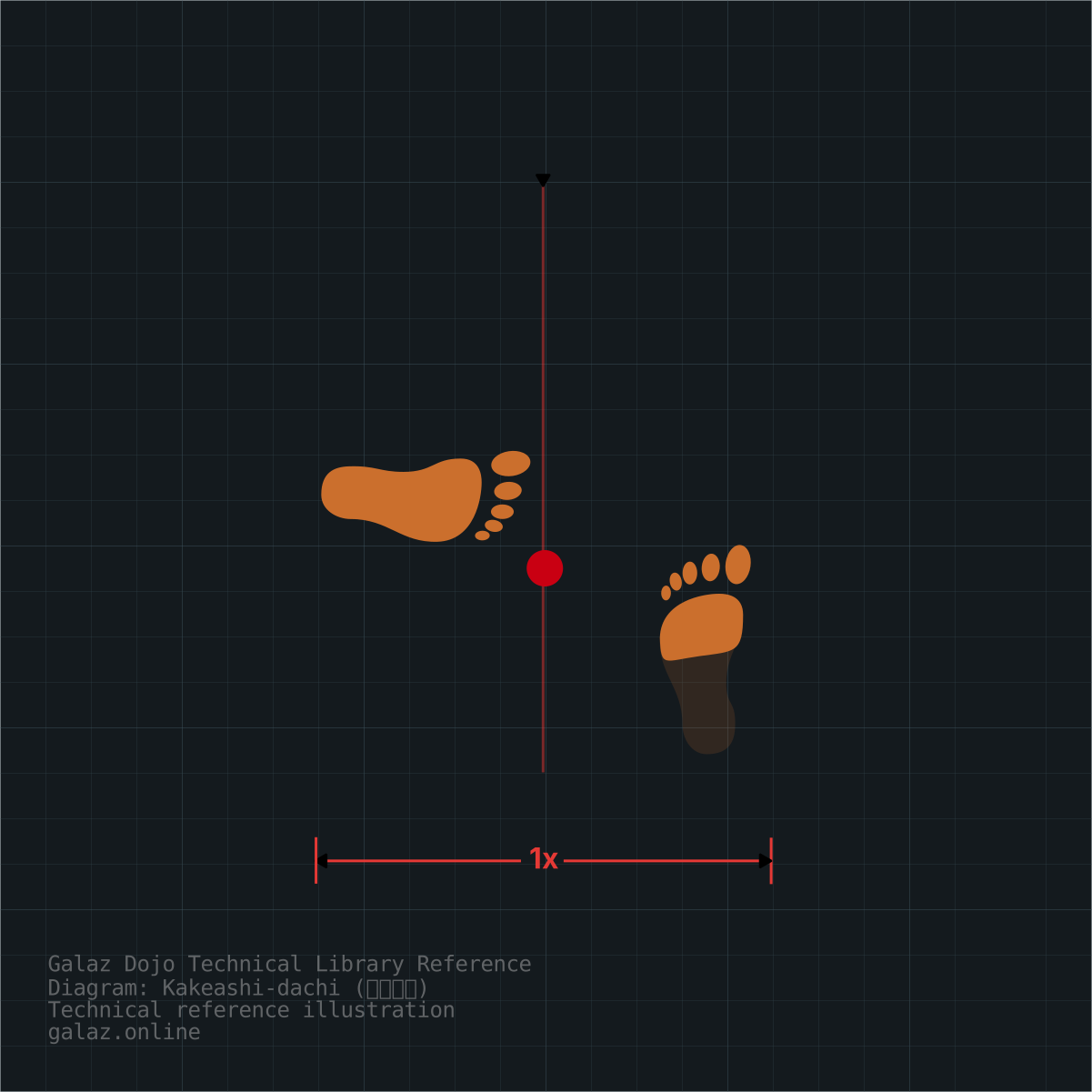
The figure shows Kakeashi-dachi from above as a technical reference diagram. It shows the main supporting foot, the placement of the hooked rear leg, the direction of the stance and an approximate lateral marker.
The 1x marking should be understood as a pedagogical proportion showing that the stance is compact and narrow. It is not an exact measurement from Oyama. The centerline and center-of-gravity marker should also be understood as pedagogical aids for explaining structure, direction and balance, not as absolute anatomical points.
Structure and form
Feet
The supporting foot is placed firmly against the floor and functions as the main weight-bearing point of the stance. The other leg is brought behind the supporting leg so that the foot hooks behind the front foot.
In Oyama’s example, the left foot is hooked behind the right foot, and the weight is carried mainly by the right leg. The same principle can be mirrored to the other side depending on direction, kata or technique.
The rear foot normally maintains contact with the floor through the toes or the ball of the foot. It should not carry the stance in the same way as the supporting leg, but should help lock the form and prevent the body from losing balance.
Legs
The supporting leg carries most of the body weight and should remain active without becoming rigidly locked. The knee is kept stable in the direction of the foot so that the leg can support the body without collapsing inward or outward.
The rear leg hooks behind the supporting leg. In practical Kyokushin description, the front of the rear knee is placed behind the knee area of the supporting leg, helping to create the hooked and locked form. The rear leg should not be pressed hard against the supporting leg, but should provide controlled support.
Hips
The hips are kept gathered over the supporting leg and directed toward the technical line. Since the legs are crossed, the hips must not twist uncontrollably or drift to the side.
In the practical form, the side of the supporting leg often leads the direction forward. Hip and shoulder are therefore organized so that the stance is not merely a crossing of the legs, but a directed technical position.
Torso and spine
The torso is kept upright and gathered. The spine should be long, the neck natural and the head placed above the body.
The upper body must not lean to the side in order to save balance. If the stance requires a side lean to remain stable, it is not being carried correctly. The feeling should be compact and locked in the lower body, but still alive and ready for the next movement.
Shoulders, arms and hands
Kakeashi-dachi has no fixed arm position by itself. The position of the arms and hands is determined by context:
- in basic form, the arms may be held neutrally
- in kihon or idō geiko, they follow the technique being trained
- in kata, they are determined by the form and direction of the kata
The stance should therefore not be defined by the hands, but by foot placement, weight-bearing, hip control and balance.
Gaze
The gaze is held in the direction of the technique or movement. The head should not drop toward the feet or turn away from the intended line. The gaze helps the body maintain direction and zanshin within the compact form.
Weight distribution
Kakeashi-dachi is carried mainly by the supporting leg.
Oyama does not give an exact percentage, but describes that most of the body weight rests on the supporting leg. In this documentation, the weight distribution is given pedagogically as approximately:
- 90% on the supporting leg
- 10% on the hooked leg
This percentage should be understood as a pedagogical Kyokushin marker in line with later practical descriptions, not as an exact measurement from Oyama. The important point is that the supporting leg clearly carries the body while the hooked leg helps stabilize and lock the stance.
Center of gravity and balance
The center of gravity is kept gathered over the supporting leg. Since the base is narrow and crossed, the stance requires more balance control than wider basic stances.
Balance should be felt through the supporting leg, not rescued by the upper body. The hooked leg provides active support, but the body must not rest heavily on it. When the stance is carried correctly, it feels compact, directed and ready for the next movement.
Kakeashi-dachi especially trains the ability to keep the body stable in a narrow and asymmetrical structure. It develops control over leg placement, hip direction and the ability to move from a locked position into the next movement without losing posture.
Technical purpose
Kakeashi-dachi is trained to develop control in a hooked and compact stance. It teaches the practitioner to carry the body over one main supporting leg while the other leg is used to create locking, direction and balance.
The technical purpose of the stance is to develop:
- balance in a crossed-leg structure
- control over the supporting leg
- stability in a narrow base
- direction through hip and shoulder
- the ability to briefly lock the body without becoming passive
- transition from movement into a marked technical position
Kakeashi-dachi is therefore a specialized stance within the Kyokushin system. It is not used as a general base for basic technique in the same way as more central stances, but it is important for understanding body control in locked and asymmetrical positions.
Use
Basic training
In basic training, Kakeashi-dachi is used to train balance, leg control and the body’s ability to remain gathered over a supporting leg. It helps the student feel the difference between merely crossing the legs and actually carrying a technical stance.
The focus should be on keeping the supporting leg stable, hooking the rear leg correctly and maintaining an upright upper body without side leaning.
Kihon / Idō geiko
In kihon and idō geiko, the stance may be used to train short steps, locking after movement and control during changes of direction. It requires the weight to be transferred with precision before the hooked leg is placed behind the supporting leg.
The movement should not become a careless crossing step. It should be intentional, compact and technically carried.
Kata
Kakeashi-dachi appears in kata as a marked specialized stance, often in connection with jumps, turns, changes of direction or powerful hand techniques. In such contexts, the stance functions as a brief locking of the body where balance, direction and technique are gathered into a clear position.
The stance should therefore be understood both as form and as transition: it shows how the body can stop, lock and direct power within a compact structure.
Kumite / application
Kakeashi-dachi is normally not a free kumite stance. It is too narrow and locked to function as a long-term fighting base.
However, it has applicative value as a principle: it trains balance in a crossed position, quick recovery after a change of direction and the ability to keep the body organized even when the legs temporarily enter a narrower structure.
Technical key points
- Hook the rear leg clearly behind the supporting leg.
- Let the supporting leg carry most of the body weight.
- Keep the supporting foot stable against the floor.
- Let the rear foot maintain light contact through the toes or ball of the foot.
- Keep the hips gathered and directed.
- Keep the upper body upright without side leaning.
- Use the hooked leg as support, not as the main weight-bearing leg.
- Let the stance be locked but not stiff.
- Keep the gaze in the direction of the technique or movement.
Common mistakes
Common mistakes in Kakeashi-dachi are:
- placing too much weight on the rear leg
- failing to hook the rear leg clearly behind the supporting leg
- allowing the supporting foot to lift, twist or lose its anchoring
- placing the rear foot too heavily or too far away
- pressing the knees together in a tense and unnatural way
- turning the hips away from the technical direction
- leaning the upper body to the side to compensate for poor balance
- turning the stance into a passive crossing step instead of an active technical form
- dropping the gaze or losing direction
Comment
Kakeashi-dachi is a small but important specialized stance in Kyokushin. It shows how the body can be carried in a narrow, hooked and asymmetrical structure without losing posture, balance or direction.
In Oyama, the stance is defined simply through the hooked foot placement and the clear weight on the supporting leg. In practical training, this develops into an exercise in balance, locking and controlled transition. Correctly performed, Kakeashi-dachi is not an accidental crossing step, but an intentional technical position.